Tuesday, 21 February 2012

Future of Power ( Part I )

Like with my post about Libya, this post has become rather long and so will be split in several parts. This is Part I.
As has been seen from the disaster in Japan, and before that in the US and the USSR, nuclear power can be very dangerous. This article is going to talk about the different types of power generation available and what I think should be done. After giving an overview on some of the different sources of power I will mention what I think would be the best course for the future and the world. 
Nuclear Energy
"Nuclear power will help provide the electricity that our growing economy needs without increasing emissions. This is truly an environmentally responsible source of energy." - Michael Burgess 
One of the most controversial sources of power, nuclear power can power entire countries with little to no greenhouse gas emissions. Nuclear power carries with a certain cleanliness that most other sources of power do not have, this is taking into account the amount of power generated from a nuclear power station.
France for example gets a majority of its energy from nuclear power stations. While some other countries do not even have any nuclear stations. Nuclear power does come with several disadvantages and those are pretty massive disadvantages.
Almost all nuclear plants that are in use today have the risk of melting down. This is basically when the things that generate the power get so hot that they literally melt and generate massive amounts of dangerous radiation. It is more complicated than this, but basically, many people can die or can get horrible diseases or genetic mutations which they can transmit to their children.
Another major disadvantage is that generating nuclear power also generates nuclear waste. This waste is basically what is left over after the fuel has been used up. No one knows what to do with these millions of barrels of waste and so they are usually just held in some cooling pool (since they can also still output dangerous radiation too and need to be cooled down for a while) until they can be put in a massive storage facility to be forgotten about. Of course that's not a very good permanent solutions and some countries have been known to sell some of the waste to other, usually poorer, countries so they do not have to deal with it. This has been reduced lately, but probably still happens.
There is however one thing that countries can do with the waste and that is to use it once more for fuel. The advantage of doing that is that the waste of that is about 75% smaller, which means a lot more of it can be stored away. The disadvantage is that after being re-used or reprocessed, the fuel can then be used in weapons with enough engineering capabilities and some effort. This is why the US has not been reprocessing its nuclear fuel for decades. Other countries have done so however. Some countries are afraid that this fuel, which isn't as closely guarded as military equipment can be stolen or sold to rogue entities, which might use the reprocessed fuel in a very dangerous and harmful manner.


The advantages of nuclear power is that it is 'cleaner' than coal and other fossil fuels, in absolute terms, less of it is needed than coal. The following numbers only serve as an example and are not true, but serve to demonstrate my point.
If 10 tonnes of coal are needed to power 10 houses for a year, then 10 tonnes of nuclear fuel can be used to power 500 houses for 5 years. That's what I mean by less of it is required. It is basically more efficient than coal and gas.
While the Fukushima disaster has put a big dent on nuclear energy, people should think twice before dismissing it outright. Many advances in technology nowadays allow for safer plants with more and more rigorous safety measures. The newest generation of nuclear power plants are not only safer, but also more efficient. It is important to realize also that the Fukushima plant had been running for almost 4 decades before and earthquake and a flood hit it. Before that, it had been running without incidents for all that time.
In addition to all of this, another source of nuclear energy is called thorium. Unlike Uranium, it does not have the properties to allow for a nuclear meltdown and thus spares people all the nasty repercussions of those. Thorium is quite plentiful in some regions of Earth and as such could be used by some countries as a perfect way to get energy with close to no downsides. From my understanding, it is very efficient and and its only trouble is the nuclear waste.

Tuesday, 14 February 2012

Syria in Trouble

The Syrian people are being killed every day by its rulers. The government is supposed to help its people and provide for them, but instead the Syrian government is sending soldiers to attack its populace. Nothing is being done as people stay and wait passively without raising their voices. Russia and China, who are friends of the Syrian government chose to veto a UN council vote against the Syrian crackdown on the protesters.

If nothing is done, the voice of the people will fall silent to violence and bullets.
In numbers:

  • 18000 people are arbitrarily detained
  • 25000 people have sought refuge in neighboring countries
  • 70000 people are internally displaced
  • 300 people have been murdered in Homs over the last 10 days
  • 5400 people have been murdered over the past year

These are a people who are fighting for the same rights you and I have in Western countries.
Help them by voicing your opinion about it to people around you, signing petitions online and raising awareness about this.

Sunday, 21 August 2011

Libya for Dummies - Gadhafi's Last Stand (Part IV)

Part I
Part II
Part III
I know I haven't written anything in a long time and so I decided to go with a dramatic title. This is not to suggest that the events described below are any less important, because the last few weeks have seen the Arab Spring in Libya, turned rebel uprising, turned civil war, become one of the most historic shifts in North Africa for a very long time.

The East
Since the start of the uprising, the rebels had managed to take over the eastern side of Libya. Benghazi, the second largest city of Libya had been seized by the rebels and has since then formed a Council of important and well-respected people from the city to lead them. This has become the de-facto government of the rebels and has been recognized by several major governments in the world, especially in Europe. In the early days of the revolt, Gadhafi was sending tanks and troops to try and retake the east, especially the oil refineries in Ras Lanouf and Brega. This is what prompted the Arab League and NATO to push for a resolution against Gadhafi's government and with the early intention of stopping them from killing civilians indiscriminately. The whole NATO operation quickly devolved into an operation to remove Gadhafi from power however.

The West
The western part of Libya had been held by Gadhafi's loyalists for the major part of the uprising. A few villages on the border with Tunisia managed to keep the soldiers at bay with hit and run tactics and probably manage to even get weapons from across the border (this is speculation on my part). It's not been until quite recently the the rebels in the west have managed to push through. They managed to get ahold of Zawiyah, which is only 50km away from Tripoli (the capital of Libya) about a week ago and this has finally gotten the people in Tripoli to restart their opposition movement to Gadhafi.

Tripoli - Bastion of Gadhafi
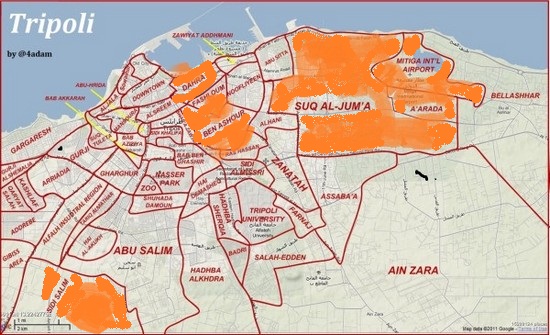
Gadhafi has managed to hold on to Tripoli from the onset of the protests months ago. For the past two days however, things have changed. Whole quarters of Tripoli have been taken by the opposition and they have apparently even managed to keep these from loyalist troops.
The image below, taken from www.juancole.com, shows exactly what I mean.
The orange areas are the ones under rebel control. If you're still reading this, you might want to head over to that website. He is more knowledgeable about it than I am. If all you want is a basic overview, keep reading here.

If Tripoli falls, that would most likely mean the end of Gadhafi. If he's not yet in hiding, that's probably where he would be soon enough. Rebels from the east and the west are going towards Tripoli to aid the rebels in the city. If all goes well, this should be as bloodless as possible and Tripoli should join the Council in Benghazi and slowly form a new government in the next few months to a year.
The only thing I fear is that Gadhafi will stay in hiding and plot terror strikes against the people of Libya, which would keep Libya in a state of peril for a long time.

Let's hope everything turns out for the better.

Tiny update: Map of Tripoli
The map shows hourly updates from residents and from the "Freedom Forces" in Tripoli.

Saturday, 18 June 2011

Sex Scandals Everywhere

I thought the following image to be pretty funny in spite of recent events.
I don't have time to explain this right now, but if anyone wants me to, drop a comment and I would in a few days.

Sunday, 5 June 2011

Dilemma ( Part II )

You can read part 1 on the following link: Dilemma ( Part I )


In Part I, I asked you to answer a question. 
Basically, the idea was that you had to decide between releasing someone into the general population who is infected with some virus which would kill thousands of people or kill him yourself, thereby saving millions but having to murder someone yourself. One of the major points of the question though also included the fact that the person was very willing to go back, no matter the consequences. Another one was that your actions would not be known by anyone but you. You're also supposed to consider that you are a doctor and have sworn an oath to save the lives of your patients.


"Release Him"
This part of the thread is for people who decided to release the person. The reason such people usually give are the following:
- I will not murder someone else as it goes against everything I believe.
- I would want to murder him, but I do not believe I would be able to do it. (If someone else does it, that's ok though) 
- Murdering is wrong/Pure Pacifism
- What the person does after he leaves my care is not my trouble. I am supposed to 'do no harm' first and foremost.
- I cannot be responsible for actions taken by all other people in the world, I need to heed my own ones and I have done all I can.


There probably would be a few more, but these relate to most of them. 
For these people I would like to ask a similar question, except that now your family lives in the patients hometown and some of your family members are part of Group A, the group that would die if he were to return home. Would you now act any differently ?


"Kill Him!"

This part of the thread is for people who decided to kill the person. The reason such people usually give are the following:
- Since the person knows he is going to be hurting people if he comes back, he is basically murdering them and so I am justified to murder him.
- Numbers. How many people would die if he went back and how many would die if he would not. Since the number is greater if he were to go back, it is justified to murder him.

These two are the most probable answers people would give to kill the patient.
To these people I would like to show them an excerpt of the modern version of the oath of Hippocrates, which is an oath doctors prescribe to in the US and in some other places in the world:
"I will respect the privacy of my patients, for their problems are not disclosed to me that the world may know. Most especially must I tread with care in matters of life and death. If it is given to me to save a life, all thanks. But it may also be within my power to take a life; this awesome responsibility must be faced with great humbleness and awareness of my own frailty. Above all, I must not play at God." - source: Hippocratic Oath
Or another one would be the "Physician's Oath" in the Declaration of Geneva:
 "I will practice my profession with conscience and dignity; the health of my patient will be my first consideration" - source: Physician's Oath
Does this not mean that as a doctor, you should not be the one who decides on the faith of others ? Your one and only task is to take care of your own patient ? As a doctor, your task is to be dedicated to life only. 
Would this not mean you would be in breach of two of the most widely used oaths which esteem the life of the patient as its main consideration?


Looking forward to hearing some responses here.
Isn't thinking just amazing ?