Here's the link: Libya for Dummies ( Part I )
I want to make sure that everyone knows this is still just my opinion and I might be wrong about some things. I would be glad to be corrected via comments.
What's Going to Happen ?
Earlier I had thought this would be over pretty soon with Gadhafi running out of money once he lost his major oil ports, which meant he would lose his mercenaries and thus probably lose everything. Apparently, I was wrong. Gadhafi has been holding out very well, which means he must have other assets somewhere which have not been frozen yet, I believe.
This means this can become a very long and protracted war. I believe the best option would be for the East and West to separate, but that's probably not going to happen, since Gadhafi wants his oil back.
Of course there are several possibilities and I'm going to state a few I think are plausible enough.
- The rebels get better training and weapons and manage to take over more cities and most of the country in the end. This would probably result in the loyalists becoming the new rebels, hiding underground and start undertaking terrorist attacks if Gadhafi manages to stay alive. With all the tribal mentality, this might end up in some ways similar to the ethnic strife in the other African countries like Congo, except with mind of getting back to power.
- The rebels get better training and weapons and manage to take over more cities and most of the country in the end. They manage to capture/kill/exile Gadhafi and the rebuilding of the country recommences with a new government slowly taking shape in some form.
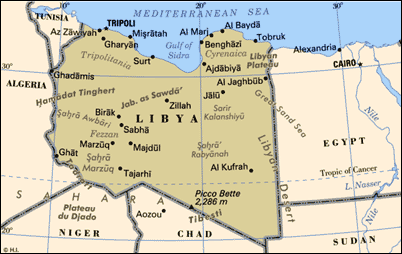
- Gadhafi manages to make a very strong push on Misrata, takes it over and pushes hard onto the Eastern ports and keeps his fighters close enough so no one would risk attacking, just like the rebels did before. If he can then find a way to stop there and then whilst keeping control of the ports, that might still be a possibility for peace.
I don't think Gadhafi can retake his whole country.
Misrata
There is, right now, a tragedy occurring in Misrata. Gadhafi has stationed armor and snipers in the city who have killed many. This is to try and stop rebels from keeping the city, but also to instill fear into any people who might consider joining the rebels. He is currently doing a good job at keeping the rebels at bay, but unfortunately, he is murdering many civilians in the process. The other problem he has is that most people in the city are probably not very happy with him right now and if he retreats his terror troops (due to a rebel attack or due to some other reason), Misrata will probably once again be controlled by the rebels, which means there is close to no point in doing what he is doing right now. He will have to keep a very strong presence there from here on out until he dies to make sure the people there do not turn against him.
The Issues
I said before I would talk about several issues and I wasn't expecting to write so much about Libya in general, but I would start now.
The US and other Western countries are just in this for the oil
This is a very interesting issue, which if this had happened more than 4 years ago might have made sense. However, as it stands, it does not. Italy, especially, but also other Western countries had major oil contracts with Libya prior to the conflict, these companies are losing million due to more than 1 million barrels of oil they could have had per day from Libya.
Another point to make is that no Western government has had any regular troops on the ground to help the rebels. Which means no Western country would have direct access to the oil whether the rebels win or lose.
This is exactly like Iraq in 2003
Well, no it isn't. Why ? Several reasons would be:
The invasion of Iraq was a unilateral decision made by the US whereas in this conflict the US played a minor role compared to 2003. This resolution was approved not the UN, unlike what happened in 2003. This time the Arab League also approved the action, which they certainly did not do in 2003. Also, this is not an invasion, this was specifically requested by the rebels themselves.
We do not know who we are aiding i.e. Who are the rebels ?
This is actually very interesting and partially true.
Let's start with seeing who they are. The rebels comprise of many different tribal people all over Libya, the fighters being between 18-40 years old and probably most male. Some parts of the rebels were ex-soldiers who have deserted Gadhafi and these elements have been very useful at training the rebels, but in so doing have also gained a lot of prestige withing the Libyan rebel camp, which might mean future leadership position and considering that Gadhafi was a military Colonel, that doesn't sound too good.
The other part of the rebel leadership is civilian and that is mostly what can be seen like in cities like Benghazi, where prominent members of the community started making transitional governments already. Most of the leaders seem to be well-educated people such as lawyers.
When people say we do not know who we are aiding this is probably not so true however, since leaders from several countries have already met with the transitional government's leaders and some countries have even set up ambassadors to the rebel government.
What I believe is that the rebel group is very broad and cannot be easily detailed and until the conflict is resolved, we probably would not know much about it unless someone who is knowledgeable about Libyan politics starts analyzing the different factions.
NATO and the US have no choice but to start a full-on invasion if they want to succeed
This is certainly not true. The rebels have enough supporters and taking over their (possible) victory by sending an overwhelming force to 'save the day' would reduce their revolution into nothing more than something that will look like another evil imperialistic move by everyone else in the world, which in the end would only turn out badly for most people.
Why Libya ? Why not Yemen, Syria, Bahrein,... ?
Well, many reasons exist for that and not all of them are as resoundingly nice as the reason given to help the rebels: "We need to save the civilians"
One of them is that every country on this planet except for some African and maybe South American countries (with no real say in the rest of the world) hates Gadhafi's guts. Gadhafi has insulted most of the world's leaders including Saudi Arabia's quite recently. Libya's rebel force asked for help, where most others have not, probably because they hate the Westerner's and don't want them involved as they see Westerners as imperialistic. Libya is much closer to the European sphere of influence than Bahrein and Syria which are all enclosed by other Arab countries and where the Arab Peninsula's leaders seem to be trying make it by themselves with Saudi Arabia even sending troops to Bahrein.
NATO had prepared (at least some of) the strikes before it was even approved by the UN
This seems to be quite clear. After the UN had given its approval, NATO had managed to cripple Libya's air force too quickly for it to have been by accident. This might mean that even without full UN approval NATO might have gone forward with the plan to at least break down Libya's air force on its own. None of this is for certain however.
Conspiracy against Libya/Resolution passed too fast
People usually complain when things happen too slow in the UN or that the UN does not act and is just a resource hog that takes money and nothing useful happens. Now we hear people talk about this happening all too fast. The President of France, Sarkozy managed to get most of the European nations to agree to the resolution, managed to get China and Russia NOT to veto the resolution of the UN and most of all managed to make all of the Arab League agree to it.
This seems like too much to be a coincidence. The only problem is that the motives behind such a move are too obscure to be certain. It does seem unlikely for so many countries to have acted with such swiftness if there had not been anything going on behind the curtains. Even China and Russia must have gotten something for their abstention, especially since China had the most foreign workers in Libya when the conflict began.
The Arab League agreeing to such action is also very peculiar since most of them have the very same protests happening right now in their own countries.
My only idea about this would be that they received some kind of guarantee to deal with their own problems if they agreed to help the western countries fight against Libya, but I am just guessing right now.
It is very odd, indeed.
Conclusion
Libya's conflict is not a simple one and might be a long one too unfortunately. All people can hope for is for it to be as bloodless as possible, since there is no way to know what would happen after the conflict ends.
We do not even know all of the details why exactly everyone joined in to fight against Gadhafi. This conflict however, if it is a fight for democracy by the people, is a valid fight in my opinion has it happened in France more than 200 years now. It is these kinds of revolutions that change countries. The problem is that there is no way to know how good or bad the changes are until they happen.
Let's all hope and pray that it will all turn out for the better, whatever it is.
Addendum
In a comment left in Part I, someone asked why a father, called Koussa, would name their child Moussa. My guess is that it rhymes with his own name and he likes Moses better than Mohammed.
Kidding aside, Moussa, Musa, Mussa is the Arabic name for Moses and is considered a prophet by the three major Abrahamic religions. It is a widely used name in Hebrew as Moshe or Moishe and in Arabic as Musa, Mussa or Moussa. Since Musa is an important prophet for Islam, I guess Koussa liked Moussa as a name for his son. By the way, I'm not even sure if Moussa's father is called Koussa.
Why am I talking about a guy named Moussa right now is actually quite interesting. This guy was a minister in Libya to Gadhafi and thus a very important and highly ranked person. The reason I'm saying 'was' and not 'is' is because he recently defected (not defecated) to the UK.
Many people question his reasons for defecting, while he himself said he could not bear the suffering he saw and the crimes committed by the Libyan forces.
A lot of people believe the only reasons were that he wanted his assets unfrozen, which have already happened, and that he didn't want to get hung out to dry when Gadhafi's government finally falls.
Even though most people are probably right in those allegations, this has serious repercussions. It means that Gadhafi is losing support, even of his inner sanctum. This could be a tremendous loss for him in the long run if all the competent people he could count on leave him one by one and he is left with nothing more than a complete puppet regime. Only time will tell.
I hope you enjoyed this article.
Update: Libya for Dummies Part III has come out:
Libya for Dummies ( Part III )
Addendum
In a comment left in Part I, someone asked why a father, called Koussa, would name their child Moussa. My guess is that it rhymes with his own name and he likes Moses better than Mohammed.
Kidding aside, Moussa, Musa, Mussa is the Arabic name for Moses and is considered a prophet by the three major Abrahamic religions. It is a widely used name in Hebrew as Moshe or Moishe and in Arabic as Musa, Mussa or Moussa. Since Musa is an important prophet for Islam, I guess Koussa liked Moussa as a name for his son. By the way, I'm not even sure if Moussa's father is called Koussa.
Why am I talking about a guy named Moussa right now is actually quite interesting. This guy was a minister in Libya to Gadhafi and thus a very important and highly ranked person. The reason I'm saying 'was' and not 'is' is because he recently defected (not defecated) to the UK.
Many people question his reasons for defecting, while he himself said he could not bear the suffering he saw and the crimes committed by the Libyan forces.
A lot of people believe the only reasons were that he wanted his assets unfrozen, which have already happened, and that he didn't want to get hung out to dry when Gadhafi's government finally falls.
Even though most people are probably right in those allegations, this has serious repercussions. It means that Gadhafi is losing support, even of his inner sanctum. This could be a tremendous loss for him in the long run if all the competent people he could count on leave him one by one and he is left with nothing more than a complete puppet regime. Only time will tell.
I hope you enjoyed this article.
Update: Libya for Dummies Part III has come out:
Libya for Dummies ( Part III )

